

Retirement planning often feels like a distant concern, but the decisions made today regarding your Individual Retirement Account (“IRA”) will impact your financial outlook dramatically. An IRA is an effective means by which you can save on taxes and create wealth over time. It’s not difficult to establish an IRA; there are basically two major types: the Traditional IRA and the Roth IRA.
The Traditional IRA allows you to deduct your contributions from your taxes at the time of the donation while only being taxed at the time the account is depleted. Conversely, the Roth IRA allows you to pay taxes on the contributions prior to placing funds into the account; however, those funds will grow tax-free and be withdrawn tax-free when you reach retirement. Both methods of establishing and funding an IRA will enable your money to grow more quickly because the Internal Revenue Service will not take a percentage of your earnings every year.
Using the correct type of IRA at the appropriate time can help ensure that whatever you save today gets maximized by the time you retire! Here are some ways to use your Individual Retirement Account, regardless of age.
Why is IRA planning important for building wealth?
An IRA is just a savings account; it’s a tax-advantaged savings tool that gives your money two big advantages: it grows faster because of tax breaks, and you keep more of what you earn over the long run. The earlier you start using it, the more powerful it becomes.
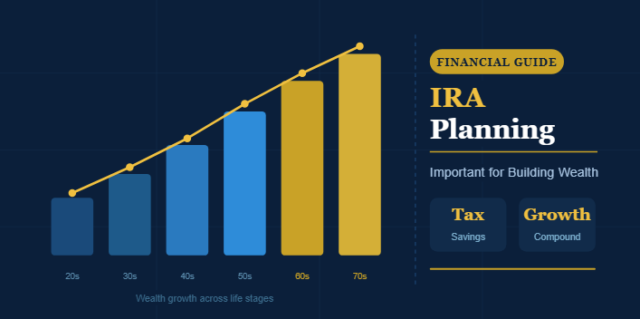
Stage 1. Start early, the foundation of wealth
The early stage should begin in one’s teens and early 20s. At this stage, you are usually in the lower tax brackets, which makes a Roth IRA an excellent choice. In which you pay taxes on the money before you put it in, but from that day forward, your money grows completely tax-free. When you withdraw it in retirement, you pay zero taxes.
Under a Roth IRA, you are allowed to put in $7,500 each year in 2026 if you are below 50 years old. There is no need to be intimidated by the figure mentioned above because even small amounts of money like $100 or $200 each month, make a big impact if started early. Arrange for automatic monthly investments to ensure that you don’t miss out on your savings.
Stage 2. Accelerate your savings (your early career stage: 20s-30s)
In this stage your career starts and grows, your earnings begin to increase, but at the same time, you may be in a lower tax bracket than what you may achieve in the future stages of life. For this reason, this particular stage is essential for maintaining consistency when managing an IRA.
A Roth IRA contribution during this time is an excellent choice. You will still have your earnings taxed at a relatively low rate, thus allowing your investment growth without further taxation for several decades into the future. This is one of the best approaches to accumulating wealth with plans for reducing future tax payments.
Apart from the regular IRA contributions, the next step is to contribute more as your earning capacity increases. Even a small increase in contribution percentage every year can help a lot in building savings. In case there is an employer-provided pension plan, it is necessary to maximize your contributions to get the total company match, which is free money.
Stage 3. Maximize the savings in your 40s-50s
These are the years when you reach your peak earning years. Although the earnings are at their peak, so are our expenses, like mortgage, children’s education, family responsibilities, and daily living costs.
So, in this stage, a traditional IRA is the most sensible option. You can deduct your contributions from your taxes right now, which helps you save tax immediately when it matters most. That tax saving can give you extra cash for current needs while your retirement account continues to grow.
Many people choose to split their contributions between a Traditional IRA and a Roth IRA. This “tax diversification” protects you whether taxes go up or down in the future. Try to increase your IRA contributions with every raise or bonus. Even an extra $50-100 per month can add up to a huge difference over time.
Stage 4. Catch Up and Prepare (Your Late 50s and Early 60s)
Once you turn 50, you get a special advantage called catch-up contributions. In 2026, you can add an extra $1,100 on top of the regular limit, for a total of $8,600 per year. This extra amount can seriously boost your savings in your final working years.
Your income is still high, so the tax deduction from a Traditional IRA can be very valuable. If you have a year with lower income (for example, after changing jobs or before full retirement), consider converting some money from a traditional to a Roth IRA. You pay taxes now at a lower rate, but enjoy completely tax-free withdrawals later.
If your spouse has little or no earned income, open a spousal IRA and contribute on their behalf. This doubles your household’s ability to save tax and build wealth. Keep your portfolio balanced still growing, but safer to protect what you have already built.
Stage 5. Enjoy and Protect Your Wealth (Your 60s and Beyond)
Retirement finally arrives, and the goal changes from saving to spending wisely. Now you want your money to last as long as possible while continuing to save tax.
If you have a Traditional IRA, you must start taking Required Minimum Distributions (RMDs) around age 73. These are taxable, so careful planning is important. A Roth IRA gives you more freedom because there are no lifetime RMDs.
Many smart retirees do Roth conversions in the early years of retirement when their tax rate is lower. You can also use IRA funds to make charitable donations, which helps lower your taxes. By mixing withdrawals from regular savings, a Traditional IRA, and a Roth IRA, you can keep yourself in a lower tax bracket each year and make your savings last longer.
Conclusion
No matter which stage of life you are in right now, an IRA is one of the simplest and most powerful ways to save tax and build wealth. The beauty of an IRA lies in its flexibility; it grows with you through every season of life. Start where you are today. Open the account (or both Traditional and Roth if it fits your needs), set up automatic contributions, and stay consistent. Small, regular steps taken over time can create real financial freedom and peace of mind in your later years. The best time to start was years ago. The next best time is right now. Your future self will thank you for the smart choices you make today.
FAQs: Frequently Asked Questions
Question 1. Should I choose a Traditional IRA or a Roth IRA? I’m confused?
Ans. The best method would be to use your own tax status as a basis for decision-making. If you happen to be having a low income, or rather a lower tax bracket, at the moment, a Roth IRA would be the preferred choice.
Question 2. What are some of the mistakes that people tend to make with their IRAs?
Ans. One major mistake that people tend to make is postponing their investments and failing to invest regularly. The second major mistake that people tend to make is failing to adjust their investment strategy as their income changes.
Question 3. What exactly does an IRA do to help me save on taxes?
Ans. When you open a Traditional IRA, it reduces your taxable income for the current tax year. This means that you will pay less tax now compared to if you did not have a Traditional IRA. With a Roth IRA, you will have the ability to avoid taxes at the time of withdrawal by making tax-free withdrawals later in life. Both Traditional and Roth IRAs help you accumulate interest on the money that you save in them over a long time period.
Question 4. I’m in my 40s now. Am I too old to build wealth in an IRA?
Ans. No, it’s not too late for you! You might have less time than someone in their 20s; however, you can still make a significant difference by increasing your contributions today.
