
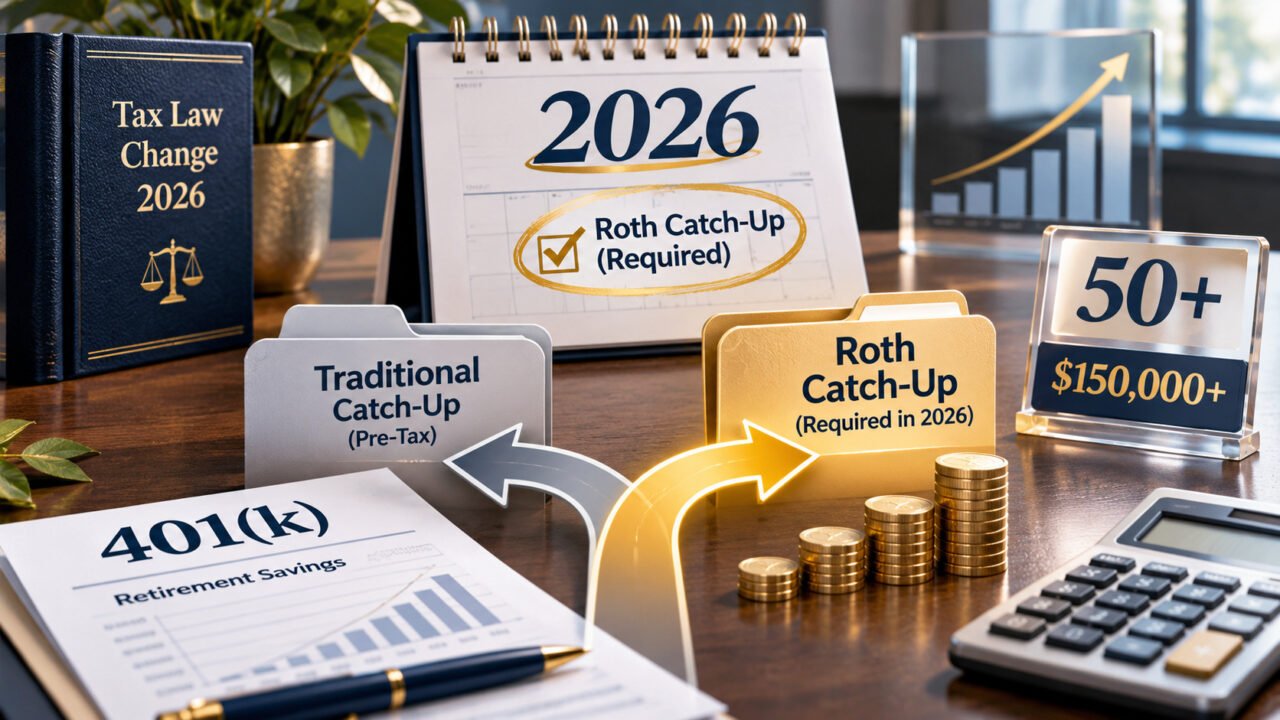
In 2026, retirement savers face a notable shift in how catch-up contributions to 401(k) plans are treated for tax purposes. Under the 2026 401k catch-up Roth requirement, workers aged 50 and over with sufficiently high earnings will no longer be able to make extra catch-up contributions on a pre-tax basis. Instead, those catch-up contributions must be made as Roth (after-tax) contributions, meaning they are taxed up-front but can grow and be withdrawn tax-free in retirement if qualified.
What the Roth Requirement Means
Traditionally, older workers who are eligible to contribute extra beyond standard 401(k) limits — called catch-up contributions — could choose to make these contributions as pre-tax, thereby reducing current taxable income, or as Roth, which does not provide an upfront tax break. Starting in 2026, if a worker earned more than a set income threshold in the previous year (roughly $150,000 for most plans), those catch-up contributions must be made as Roth contributions.
Understanding the differences between Roth 401(k) vs. Traditional 401(k) contributions can help retirement savers evaluate how current tax benefits compare with potential tax advantages during retirement.
Why the Change Matters
This rule affects when taxes are paid. Pre-tax catch-up contributions reduce taxable income in the year of contribution, while Roth contributions are made with after-tax dollars. The new Roth requirement eliminates the immediate deduction for high earners but offers the benefit of tax-free growth and withdrawals later on — a valuable feature if your tax rate in retirement is higher than during your working years.
Effective tax planning for high-income earners can help individuals evaluate the immediate tax impact of Roth catch-up contributions while considering their long-term retirement savings goals.
Who Is Affected
Employees who are 50 or older and whose prior-year wages from their current employer exceed the income threshold (commonly around $150,000) will need to make their catch-up contributions as Roth contributions in 2026. Workers below that threshold can still decide whether to make catch-up contributions as traditional pre-tax or Roth, depending on their plan options. If a retirement plan does not yet offer a Roth 401(k) option, high-earning participants may be unable to make catch-up contributions until one is added.
Eligible employees should also understand the 2026 401(k) contribution limits to determine how much they may contribute through standard deferrals and additional catch-up contributions.
Preparing for the New Rule
To navigate this change, savers should review their retirement plan options and check whether a Roth 401(k) is available. Understanding whether your plan’s payroll system can handle after-tax Roth catch-up contributions is essential. Consulting a financial or tax professional can also help you balance tax planning, current income needs, and long-term retirement goals under the new rule.
Exploring tax planning strategies for building Roth assets can help individuals assess contribution options, potential tax consequences, and retirement income needs before making financial decisions.
FAQs
What Is the New Roth 401(k) Catch-Up Contribution Rule for 2026?
Starting in 2026, employees aged 50 or older whose prior-year FICA wages from the employer sponsoring their retirement plan exceeded $150,000 must make eligible 401(k) catch-up contributions as Roth contributions when the plan offers the applicable Roth feature. These contributions are made with after-tax income rather than pre-tax dollars.
How Does the $150,000 Income Threshold Affect 401(k) Catch-Up Contributions?
The $150,000 threshold is based on an employee’s FICA wages from the employer sponsoring the retirement plan during the previous calendar year. For 2026 contributions, employers generally review 2025 wages. Employees exceeding this threshold must use Roth treatment for their eligible catch-up contributions.
What Are the 401(k) Catch-Up Contribution Limits for 2026?
For 2026, employees aged 50 and older can generally contribute an additional $8,000 beyond the standard $24,500 401(k) contribution limit. Employees who turn 60, 61, 62, or 63 during 2026 may qualify for a higher catch-up limit of $11,250, subject to plan rules.
Do Roth 401(k) Catch-Up Contributions Reduce Taxable Income?
No. Roth 401(k) contributions are made with after-tax dollars, so they do not reduce current federal taxable income. However, qualified Roth distributions in retirement are generally tax-free, including eligible investment earnings. This can provide valuable tax flexibility when planning future retirement income.
What Happens If an Employer’s 401(k) Plan Does Not Offer a Roth Option?
If a retirement plan does not offer the required Roth contribution feature, employees subject to the mandatory Roth catch-up rule generally cannot make catch-up contributions under that plan. Employers may need to review plan provisions and consider adding a Roth option to support eligible participants.
Conclusion
The 2026 401k catch-up Roth requirement represents a significant change in retirement savings rules for higher-earning older workers. While it may eliminate an immediate tax break for catch-up contributions, the shift toward Roth treatment provides valuable long-term benefits in the form of tax-free growth and withdrawals. Adapting your retirement strategy now can help you make the most of this change and protect your savings as tax laws evolve.
